Boring (eyelets) and cording
Cut eyelets with the borer and overcast them with satin, or couch a thick cord along a path with a zigzag.
Boring: eyelets and broderie anglaise
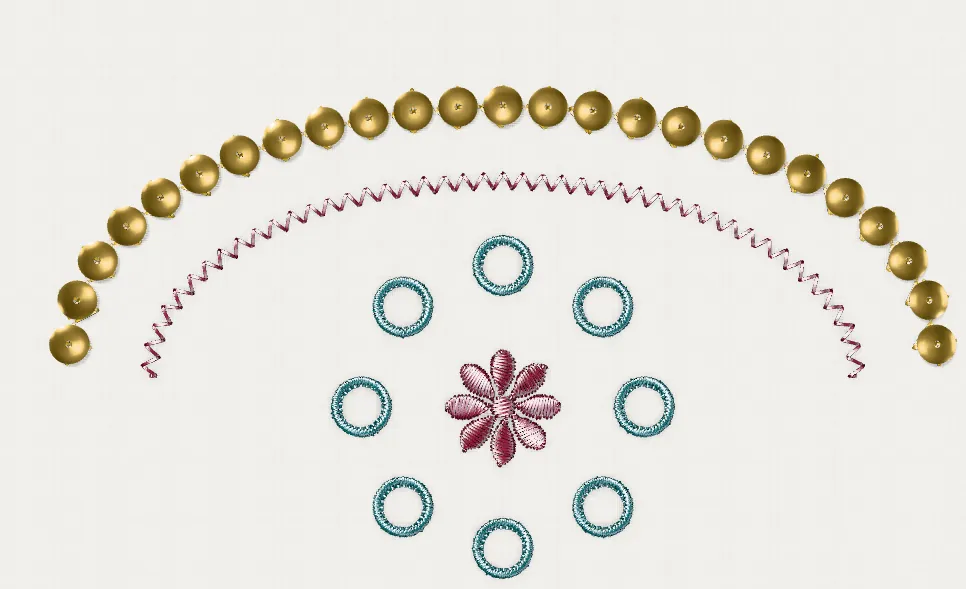
A borer is a cutting blade mounted on the machine instead of a needle. It pierces the fabric; the needle then overcasts the edge of the hole with a satin ring. This is the technique of broderie anglaise and openwork borders.
- Make sure your machine has a borer (boring knife); Tarz Studio inserts a stop so the operator switches to it.
- Draw small circles where the holes go, or select existing ones.
- In Properties → Stitch type, choose Boring.
- Set Hole diameter (default 3 mm) and Overcast width (default 1.2 mm).
- Tarz Studio sews a short running stitch around the hole to hold the fabric, switches to the borer to cut, then sews the satin ring.
Use a firm, woven fabric (cotton, linen) and a tear-away or water-soluble stabilizer. Holes larger than about 6 mm are better cut by hand with a cut-work outline.
Cording: couching a cord
Cording lays a thick cord or several threads on the fabric and holds it with a zigzag, like the traditional fetla and majboud of Algerian caftans and karakous.
- Draw the path the cord follows (open or closed).
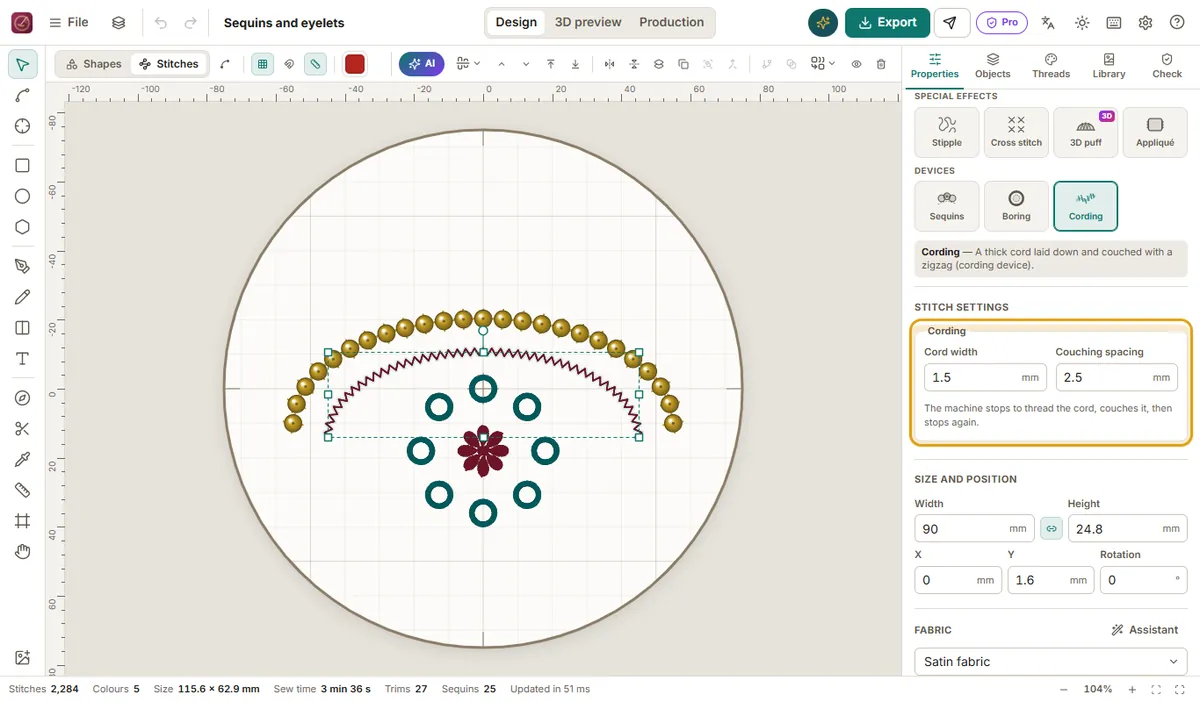
- In Properties → Stitch type, choose Cording.
- Set Cord width (default 2 mm) to the real cord you use, and Couching spacing (default 2.5 mm) between zigzag stitches.
- If your machine has a cording device, select it in the machine profile: Tarz Studio turns the device to follow the direction of the path. Without a device, the machine stops at the start so you can place the cord by hand.
Tips
- Keep cording curves smooth: very tight corners make the cord twist. Round them with Reshape → Smooth.
- Sew cording after the fills it sits on.
- Check both techniques in the 3D preview and on the production worksheet, which lists the devices and the cord to prepare.